Culture Aid NOLA (CAN) is working with Footprint Project through a grant from Elevance Health Foundation to build more green and efficient operations. More than 400 families are served with free, fresh produce at each of CAN’s twice-weekly no-barrier no-stigma grocery distributions, and through solar innovations Footprint Project aims to reduce energy use at these events.
Footprint Project, with support from Elevance Health Foundation, the philanthropic arm of Elevance Health, is partnering with CAN, Sprout NOLA, and New Orleans Community Fridges to provide solar + battery solutions for local community coolers. The Healthier Power initiative will ensure that pillars of the food security community remain resilient through disaster power outages, eliminating both food waste and greenhouse gas emissions.
“How can we help power your mission? At Footprint Project, this question is always at the core of our work. We are thrilled to be partnering with Culture Aid NOLA, whose non-traditional food bank model is a mission we’re honored to help power,” said Jamie Swezey, Footprint Project Program Director.
“The partnership with Footprint Project gives Culture Aid NOLA relief going into summer months and hurricane season. Working through blue and grey skies, it is crucial for us to have access to temperature regulated coolers to store food and access to power to continue operating on site,” said CAN Executive Director Ellie Duff.
Items like solar-powered generators, panels and temperature regulated coolers from the Footprint Project will ensure that Culture Aid NOLA can continue serving free food while keeping families comfortable and food fresh, on a weekly basis and in response to local major weather events.
“Many of the communities we serve are severely impacted each year by some type of natural disaster. By expanding our community resiliency and disaster relief grants, we are able to make a greater impact not only in the communities we serve, but for the individuals who are impacted as well,” said Shantanu Agrawal, M.D., Chief Health Officer of Elevance Health.“Together with our partners, Elevance Health Foundation will continue working to measurably improve disaster preparedness, response, and recovery efforts throughout the country.”
This new technology will power CAN through extreme weather events like Hurricane Ida, and more chronic climate issues. Due to record-breaking heat last summer, CAN had to cancel almost all late afternoon distributions in the month of August for the safety of volunteers and guests. With increased temperatures throughout the summer, being able to power misting fans and charge pallet jacks with solar power will allow CAN to deal with the effects of climate change without contributing further.
Footprint project has provided solar rechargeable batteries and a solar-powered cooling trailer that is helping Culture Aid NOLA to store and distribute produce to local families.
We’ve seen it happen disaster after disaster, since before Hurricane Katrina and most recently in Florida with Hurricane Ian. No matter how early we know a storm is heading our way or what level of impact it might have, and no matter how many times the experts tell us to leave or how to prepare, some people will not evacuate, even if that seems like the most logical option.
For some of us, evacuation is not an option. There’s no viable or affordable place to evacuate to, no transportation to get us there or we are physically unable to make the long and arduous trek. These are all legitimate reasons for staying put with a plan to shelter in place. So, we prepare as best we can, securing the supplies to get us through. But, for many, this, too, is not possible.
Stocking up on supplies and preparing for long-term power outages or damages to other critical infrastructure is expensive. It is not an option for many living paycheck to paycheck or on a fixed income. The results of this lack of options can be devastating, as happened most recently in Florida, with the deaths of those unable to evacuate and prepare for the hurricane’s wrath.
How can local, nonprofit organizations, with the help of grantmakers, donors and partners, pre-position emergency supplies to provide to people who cannot purchase or access them?
What are our options?
In the first 72 hours after a disaster, supplies such as water, shelf-stable foods and initial clean-up tools are crucial for survival. But often, they sit congregated in warehouses, beyond the reach of last-mile delivery systems that will be down for weeks. Resources are less likely to make it directly into homes after a storm as streets are blocked, roads flooded and public transportation halted.
At Culture Aid NOLA, we believe the best place to pre-position donated items for hurricanes and other major disasters is in the homes of local families not miles away and unreachable in warehouses. That’s the idea behind July Supply, the first-of-its-kind disaster preparation distribution for our community, which we often see being left behind in this response.
Culture Aid NOLA piloted July Supply last summer and leveraged a $50,000 grant from the Center for Disaster Philanthropy with more than $730,000 worth of donated goods and $24,618 worth of volunteer labor to serve 2,000 New Orleans families.
Partnerships with organizations including Can’d Aid, Conscious Alliance, Good360, Second Harvest Food Bank and more helped us source supplies for the beginnings of a “Hurricane Kit” for local families. The kits, which included more than 3,800 flashlights, 48,000 cans of water and 22,000 cans of sanitizers, were distributed at the community event on July 16 in New Orleans’ City Park.
“We were very impressed with the responsiveness and transparency of Culture Aid NOLA,” said partner Can’d Aid through the July Supply After-Action Report. Another partner also shared, “The pre-disaster approach was greatly appreciated. It gave us time to provide support and was not the norm for us as we are usually scrambling to provide support during a response.”
Getting supplies in our neighbor’s homes ahead of time gives families peace of mind before something catastrophic hits.
Why should we prepare?
In the face of rapidly intensifying storms, like Hurricane Ida in 2021, and inflation, the realities of evacuation are causing more and more families to question leaving. New Orleans’ City Assisted Evacuation Plan only accounts for 10% of citizens who don’t have cars or who have major medical needs in the face of a mandatory evacuation while almost 20% of New Orleans residents do not have a car, and 26% fall below the federal poverty level. With less accessibility to evacuation for some populations and less time to evacuate, it’s imperative to prepare communities before with supplies to last the first 72 hours of a storm.
The federal poverty line does not include undocumented persons, displaced persons, evacuees, and families that make just above the federal poverty line, who are Asset Limited, Income Constrained, Employed (ALICE). The United Way of Southeast Louisiana believes up to 57% of Orleans Parish residents are struggling households without the extra funds to leave town in the face of a storm.
These underserved communities are who Culture Aid NOLA aims to serve at our twice-weekly free grocery distributions without imposing stigmas or barriers like proof of identification, residency or income. We believe that everyone deserves access to resources to feed their families and prepare them in the face of disaster.
What’s next?
We plan to make July Supply an annual event in New Orleans. We’re sharing our story and experience with partners along the Gulf Coast and beyond so they explore replicating the program in other communities.
Keeping our neighbors prepared and ready in the face of increasing disasters is key to our communities’ equitable and speedy recovery.
Ellie Duff is the interim executive director and Olivia Morgan is communications manager of Culture Aid NOLA.
Tim Gray already knows how good it feels to find a “forever home.” While he’s new to our First Time Homebuyer Program, he’s been delivering dogs to their adoptive homes for three years now with the Villalobos Rescue Center.
Tim works and currently lives inside their main facility that houses hundreds of dogs of all breeds awaiting adoption. The shelter is the basis of Animal Planet’s show “Pitbulls and Parolees.” He began volunteering with the nonprofit as a way to stay active, and took on a full time position with the organization in 2016.
Tim helps with transports, observes and records dog behavior for analysis, and makes sure his four-legged friends get the fresh air, activity, and socialization they need. The Vermont native has worked other jobs, from being a road manager for a punk band to kitchen work and management, but he’s learned over the years that he far prefers working with dogs.
“I spend pretty much all day outdoors, which is great because I’m not cooped up inside,” he said. Tim also enjoys skateboarding and rock climbing and is a natural fit for working sweat equity hours on Habitat build sites.
“I’m a fairly self-motivated person, so I don’t like being idle,” he said, “I know that with homeownership, my dad tells me there’s always something to fix.”
Tim heard about the program through his friends and Habitat homebuyers Tyler St. Jean and Sarah Wood, who explained he didn’t have to be married or have children to apply. Not that Tim is really childless—he’s got three pitbull mixes: Jones, Alasaurus, and Gumba. Jones has been with Tim since he moved to New Orleans 12 years ago, and Alasaurus joined them when Tim lived in Holy Cross.
He met his 60 lb. “baby” Gumba two years ago when the butterscotch puppy was brought to Villalobos. After eight months of fostering, Gumba joined Tim’s family, and now he will get to live outside of the kennel in his own home for the first time. With that in mind, Tim selected a lot in the Lower Ninth Ward that has a big tree with lots of shade, a park just down the street for the pups to play, and less than a ten-minute commute to Villalobos. For Tim and his dogs, the house he will build there is a testament to years of work and personal growth to reach independence.
“I spent a lot of my life doing things that I thought would make people like me instead of what I actually liked to do, and unfortunately that led to a few problems down here,” he said. He doesn’t like to think of this as wasted time, but rather years when he found out what didn’t work. Right before he started working at the rescue, he decided to get sober. He said everything since has been a step forward to a more stable chapter that includes something he never thought he would be able to achieve: home ownership.
“Owning a home is security, independence, just that feeling of satisfaction of saying ‘I did that, cool, now what ’s next?’ ”Tim looked at several home-buying options before coming to Habitat, including a grant program and a traditional mortgage from a local bank.
“It’s a little daunting and a little confusing when you see all these numbers thrown at you,” he explained, “That’s why I liked this program. The time taken to educate you and really set you up to succeed, and how it’s broken down to where it’s not this whole big thing that you have to do to get to a house.”
He credits his caseworker Patsy for answering his questions, working with him to meet qualifications, and removing the pressure from the process. He said he’s thankful to be a part of a program that helps people help themselves and providesa way for people to gain autonomy for themselves and their families.
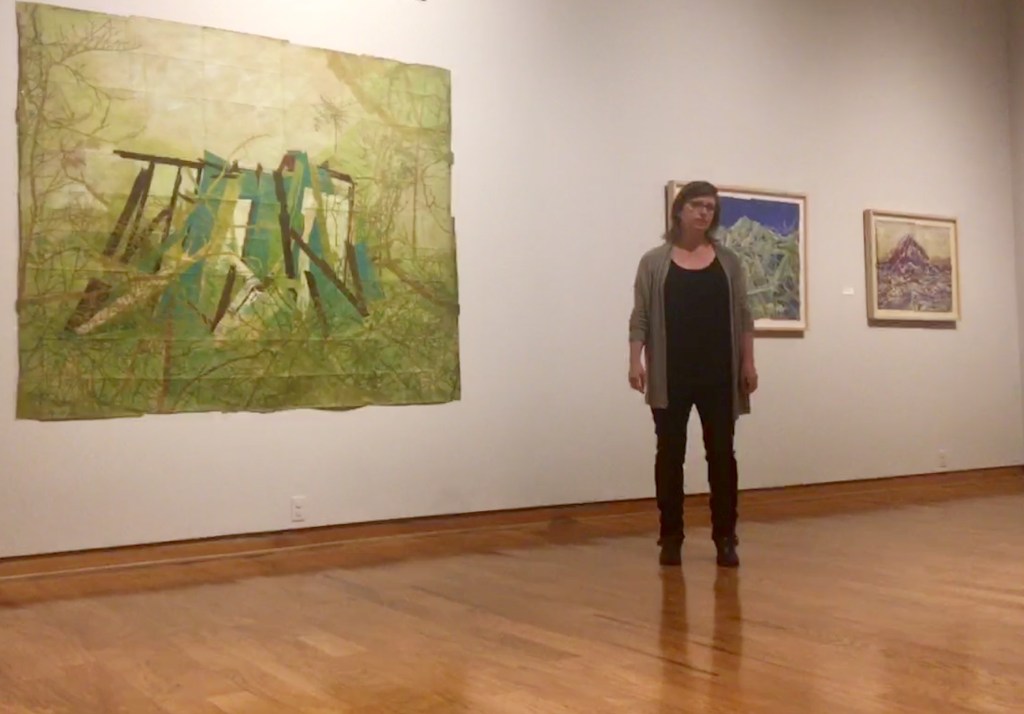
In her show at the University of Mississippi Museum, Ruin is a Secret Oasis, artist Maysey Craddock reflects on the inevitability of entropy, and the natural progression of the earth after human forces have abandoned a space.
In the collection’s focal piece “somewhere south of Violet,” blocks of blue and brown lean upon themselves while being eaten by her creeping lines of light green flora, growing up from the bottom of the painting. Her pieces employ a high level of abstraction, giving the viewer a puzzle to decode — to find the lines of the house while differentiating it from what has grown up around it.
“People are not in the work, but humanity is in there,” Craddock said. Most of her work is landscape-based, but includes man-made structures in the early and late stages of decay.
“I was really interested in the idea of ruin and nature and that kind of collapsing of architecture and the reclamation of nature,” she explained.
The artist, who returned to Memphis in 2008, said she has come to see ruin in her everyday life, including a gaping hole in the top of a building next to her studio. She finds inspiration and sense of place in the works of fellow Memphian and photographer William Eggleston, and also looks to the sublime landscape paintings of the early 1800s. Her appreciation of form and construction comes from her training in sculpture.
She works from line drawings made from carbon paper and photographs she’s taken of run-down shelters on road trips through the deep south, pulling from places like rural stretches outside of her home in Memphis, the Mississippi Delta, the Alabama coast, and isolated lands south of New Orleans in Louisiana. Sometimes she seeks to find places, sometimes the places find her.
“I’m interested in that place where land and water meet, that really ephemeral landscape and so it’s a little political for sure, how are we preserving the landscape,” Craddock added, “And also, of course there are larger geographical forces at play.”
Craddock said that she is drawn more to matte and velvety textures, as opposed to oils. Her work is painted on used paper grocery sacks, sewn together with silk threads. The materials use suggest a “foundness” to the work, a tactility that feels more authentic than a traditional canvas. She said that sometimes when she collects the bags from friends she often finds receipts and shopping lists within the bags, giving them a sense of material history.
Though abandoned, her pieces also have a profound sense of movement. In one pieced, entitled “Gravity Sky” sharp white directional lines show the explosion of a home. These gestural strokes against a grey wash background make the building appear as if a tornado is deconstructing it in the very moment. Craddock said this piece led her where it wanted to go, becoming less and less constructed as she worked on it.
She paints with gouache, an opaque watercolor, often creating washy swatches with layers of more intricate details. She uses a variety of hues, from stark blacks and whites to deep greens, and even ocher reds. She said a large piece takes her 3–4 weeks, adding “I always work from a vision, but most of the time the piece just says no.”
The piece entitled “Slow Burn” comes from a roadside stop near Jackson, Mississippi captured at noon in mid-August. The painting depicts a scorched structure that had devolved into a spidery-like crumple of metal beams creating interesting geometry. She uses hot blues and searing reds in wavy lines to waft the heat wave off of the page.
She also employs darker tones in a piece where the background of a shed is deeply blackened, save a few fingers of white spilling down the page, stretching and branching like bolts of white hot lightening. The piece gives one a sense of being underwater, with the building suspended in place by these white lines.
Her use of line — to lead the viewer’s eye, and to depict tree-line branches as well as coastal water currents — takes viewers into a dreamlike land where what has been touched by man has been made untouched by mother nature again.
Sustainable farming in the U.S. Virgin Islands recovering with the help of North Mississippi natives
During hurricane Maria the tree line of the Ridge to Reef farm was decimated on the west end of St. Croix Island photo courtesy of Ridge To Reef Farm
Nate Olive watched till nightfall as Hurricane Maria rolled in over the west end of St. Croix Island. He said goodnight to his sown tropical paradise of fruit orchards and vegetable fields, pastures of sheep and guest-hosting cabanas. As the winds of the storm began howling like a freight train, he descended into the on-site hurricane shelter.
He had been on this property, now the Ridge to Reef farm, for over 13 years managing farm outreach and educational programs as part of the Virgin Islands Sustainable Farming Institute until he purchased the land himself. His farm helped introduce the concept of a community supported agriculture program, or CSA, to the territory in 2010. Their CSA has since has grown to include over 400 members and encouraged four other farms on the island to take up similar practices. Typically joined by six to 10 staff members on the farm, Olive and two other staffers and a visiting couple were on the property when Maria struck.
Maria came in the middle of one of the heaviest hurricane seasons in recent history, according to the National Weather Service.
“Maria gradually intensified and became the 8th hurricane of the 2017 Atlantic hurricane season with 75 mph maximum sustained winds,” the NWS said. Following other destructive storms like Harvey, which battered the Texas coast and Irma, which also made landfall in the caribbean islands, Maria would prove to be a further blow to an already damaged, and oft forgotten section of United States territory.
“Every little detail was brown”
Olive had ridden out other storms on the farm before, like hurricane Omar in 2010, but nothing had prepared him for cracking the doors of the bunker open the next morning and coming out into a completely different world. “It definitely looked like a war zone,” Olive said. “Every little detail was brown.”
Olive’s thoughts quickly turned to rounding up sheep and donkey that roamed the property. He found them tangled between trees. He was surprised to find his own home dinged, but relatively untouched.
Yet he was severed from the outside world: the solar panels that powered the property lay crushed, and cell service was a rarity. Olive can travel to a certain hill on the island where he gets service to send out text messages and place calls. There was a place where he had internet that he could go to every two or three days and it was there that he posted Facebook updates and replied to those who had reached out to help.
Their crew of four would spend four days cutting half a mile up the drive to the main road, only to find the street itself impassable.
Before this land was a jumbled mess, it was a 180 acre functioning farm, a tropical agro-tourism destination and a place of inspiration for Como, Mississippi farmer Marshall Bartlett.
“They planted lots of native species and there are tons of trees,” Bartlett remembered, “They built these really neat structures like cool treehouses.” Ridge to Reef was also selling to the farm-to-school program under contract with the local school system.
The first time Bartlett came to the farm he was seeking a reprieve from a cold winter semester at Dartmouth, opting to take an eight-week apprenticeship at the then-Virgin Island Sustainable Farming Institute in St. Croix. He credited this time as formative in the creation of his own Home Place Pastures.
“There were several people from multigenerational row crop farms in the south trying to figure out what to do with their place and move their farm, and how they sell agriculture in general,” Bartlett said. They discussed building their farms as places to engage their communities that had seen a decline in jobs and access to healthy foods.
“I was only 19 so it definitely stuck with me and that’s where I sort of started to form the idea to come back and do what I’m doing now,” he explained. During his stay there he also learned green building techniques and animal husbandry practices that he employs at his own farm.
“When I saw pictures of the farm after the hurricane it looked like somebody went with a chainsaw and cut everything two feet above the ground,” he said. Due to the strong impact this farm has had on his own career, he reached out to the Ridge to Reef Farm via email, but his attempts were futile as the island is still mostly without internet service.
Once they finally got in touch the team hit the road on November 8th, trucking down to New Orleans to stay the night at the home of their NOLA sales representative before catching a 6 a.m. flight to St. Croix.
Team member and Home Place Pastures Chief of Operations Andy Stubblefield said the destruction was evident even from the air.
“They have all these FEMA tarps that they put over damaged roofs, and when you fly in you can see that pretty much every house had one of those tarps on top of it,” he said.
The airport, which had been the focus of most of the relief efforts, was in the best shape, but once the crew began to drive out into the country and up the mountain that the farm was on they began to notice demolished homes and downed power lines.
“You can’t rent a car there, all of the lines are down, all of the infrastructure of the island is just gone,” Bartlett explained.
He had returned not to the sunny shores of his youth, but to an island two months post-hurricane, struggling to return to normalcy. Gone was the local sleepy bar on the beach that he and his fellow farmers would hitch-hike to at sunset.
“A lot of the beaches you can’t swim in right now because the sewage system had flooded and there’s contamination in the water,” Barlett lamented.
The team members were housed not in tropical resorts, but the screened-in cabanas that had slept guests at the farm before the storm. The cabanas were still without electricity and running water when the team arrived.
“We weren’t expecting anything glamorous, we were down there to work,” Stubblefield explained.
Mother nature has seemed to recover more quickly than her children on the island. The brownness that covered everything began to flow across the property as heavy rainfall and flooding continued even after Maria had passed. Saturated farm soil no longer imposed by tree roots began to cover the roads like rivers.
There’s grass now. The deep muddiness from the rain has rendered swampy stalks ten feet tall. Bush cloaking debris on the ground, vines encasing downed trees. Vegetable crops sit ruined and rotting in the fields, munched on by stray animals.
What equipment the farm had has been put through the blender. Mowers were blown out hitting hidden shrapnel from the storm in the seeping weeds. The farm had a tractor, but it was in the shop during the hurricane. The shop was blown off the map and the mechanic was evacuated out for dialysis.
For Olive, the Home Place Pastures team would be a skilled set of hands and a boost in morale for his operation.
Bartlett and his team consisting of Stubblefield, marketing head John Jordan Procter, CSA organizer Alison Schruder and farm intern Andrew added hands where needed.
“Fruit trees from the CSA had been tipped over, and that was one of the big projects we had one day, going to each tree and pruning them and trying to push them up and support them with other trees so that they had a chance to survive and continue to produce fruit,” Stubblefield said.
The team also worked to repair grazing pasture enclosures that had be crushed by fallen trees. They worked sun-up to sun-down chainsawing trees, making burn piles, carrying trees through the brush and doing fence work.
Stubblefield said he was most impacted by seeing the affect that Ridge to Reef had on the island community. “Pretty much everywhere we went the people knew the farm and were very appreciative of us coming there and helping out,” he said.
Marshall Bartlett’s Home Place Pastures team helps to clear downed limbs at the Ridge to Reef Farm. Photo courtesy of Home Place Pastures.
Olive said Bartlett was well suited to the task because of his background in farming, and his team of skilled and willing workers. “I had never met anyone else on his team in my life, but we all bonded instantly when they saw what we are up against,” Olive said.
The team was a welcome antidote, but not a full cure. While other visits from farm supporters are in the works, healing the land isn’t Olive’s sole concern. Mortgage payments, phone bills, health insurance payments are all still due, storm or no storm. On top of that, he’s having to replace broken equipment just to get the business started again. Farming is about patience. Planning, timing, sticking to your task until it’s done, but the farm is not even in the position to plant.
According to FEMA, 6,352 individual assistance applications have been approved and $105, 405, 080 in public assistance grants have been obligated. However, farms like Ridge to Reef make too much gross income to apply for such federal assistance, mostly aimed for individuals and family households. General loans are hard to come by because of the farm’s low net profit. The island is operating on a mostly cash-only basis, which is difficult in a place without internet service for ATMs.
“The best solutions I’ve seen aren’t institutional help but individual help,” Olive said, “It’s not federal it’s just people helping people, no strings attached.”
The farm has been mailed supplies from friends across the country. There is a GoFundMe started to raise money for a tractor. He says as much as the storm surge shocked him, he is equally overwhelmed at knowing how much support he has from people, even those he hasn’t been close to in years.
“I didn’t really know that we did something good for them at some point in their lives,” Olive said. He’s got a long road ahead of rebuilding sheds and greenhouses, and getting the farm back to sustainability.
“A storm like that just effects every little detail. It just twists and bends and breaks every corner of everything,” he said. “All you can do is pick one thing and do it till it’s done. If you try to think of the whole list at once it will drive you crazy.”
Members of the University of Mississippi Faculty Jazz Ensemble are tuning up to jam at a free show at Proud Larry’s on Wednesday night.
“The idea behind it is to promote live jazz in Oxford,” said Scott Carradine the owner of Proud Larrys. “We have a tremendous jazz department at Ole Miss that doesn’t get out and play publicly enough in town.”
This is the second part of a jazz performance series at Larry’s that began when student Jazz combos performed on October fourth. According to Carradine, the student performance garnered a packed house.
“Most people who come out who come out to hear jazz on purpose enjoy what they hear and those who just kind of drop in are surprised that they have such a good time,” said Dr. Michael Worthy, who teaches instrumental music education at the University and plays trombone in the ensemble.
He plays along with fellow music professors John Latartara on guitar, Ricky Burkhead on the drums,Daniel Roebuck on the trumpet, and Greg Johnson, who oversees the Blues archive in the University of Mississippi Library, on the bass.
“Playing music with friends, there’s nothing like it on the planet, it’s the most fun thing that I do,” Worthy said.He has been playing the trombone since he was eighteen years old. He grew up listening to jazz records with his father and played in his first ensemble in the 7th grade.
The UM Faculty Jazz ensemble grew out of a conversation on improvisation between Worthy and Latartara who began playing together as a duo at cocktail parties. The band formalized into a quintet over the years that now regularly performs concerts within the music department, at University functions, and at private social engagements.
Latartara said he is looking forward to Wednesday night’s performance so that the band can play a longer set and get into some crunchier jams. Latartara, who has played guitar for 28 years, said that the best part of playing with the group is reading his fellow bandmates and following the tunes.
“A lot of it is improvised so we’re never sure who’s going to solo next or how long the solos are going to be or what they’re going to do so you have to sort of react within the moment,” he explained. “It’s really just the communication between all of us when we’re performing that I really love.”
The band has been rehearsing and discussing the set list for Wednesday night’s show for a couple of weeks now. He says they sometimes discuss solos, but mostly they just play the song and see what happens.
“Since we’ve been playing together for a few years now we sort of can hear what each of us is doing and read that pretty well,” he said.
As a professor of music theory and tech at the university since 2003, he has come a long way from when one of his first guitar teachers introduced him to Miles Davis. He hopes to foster a similar love for the music at their shows, stating that it is rare to hear live jazz in Oxford.
“Hearing live music is the best musical education you can have, it’s not like a recording or reading through a score or something on your own,” Latartar explained, “Hearing live music is really the best way to learn and understand a certain genre of music”
The event is cover free and the band will start at 8 p.m.
Faculty across the Oxford and Jackson campuses of the University of Mississippi are gearing up for the November 17 official launch of the Flagship Constellations Initiative.
Chancellor Jeffrey Vitter first announced the plans for these constellations in his investiture speech in November of 2016
“We will establish joint degree programs across disciplines and campuses, engage in the strategic growth of our graduate programs, and establish key partnerships revolving around innovation and entrepreneurship,” Vitter said in his address.
This spring the University accepted 18 full proposals from over 400 faculty members for potential areas of emphasis from across campus, and a board of University leaders from both campuses reviewed and rearranged the proposals into four categories: community well-being, brain wellness, disaster resilience, and big data.
“One thing we were conscious of when we chose these themes was that they are broad enough that they will still be relevant ten years from now,” Interim Vice Chancellor for Research Josh Gladden. “This isn’t a 3-year project or a 5-year project, it will be a decade or so.”
In planning, his office looked at other schools like the University of Wisconsin and Auburn University who have similar cross-disciplinary teams. He said that the program will provide stronger applications for grants and private funding, as well as facilitate conversations between different areas of study to come up with unique solutions to problems.
“For the student’s perspective, it’s going to provide new experimental learning opportunities,” Gladden said. “They will be starting their careers in this cross-disciplinary environment.”
“The whole idea behind the constellation is breaking down silos,” said interim co-lead of the “Big Data” constellation, Dr. Dawn Wilkins. “We all tend to be in our own building, we do our researchmaybe with collaborators across the country or the world, but sometimes we don’t look across campus.”
One of the first things she plans to do in the constellation is to develop a governance structure for the group to define the connections and themes of the program. Plans for the “Big Data” constellation include forays into biomedical data analytics, journalism.
Her department is already working on a project in conjunction with Dr. Jeffery Jackson in the sociology department, who is digitizing research on slave records from Lafayette County to enable people conducting ancestry research.
Each of the four focus areas has two co-leads, one from the Oxford campus, and another from the University of Mississippi Medical Center. Wilkins, who is chair of the Computer and Information Science department, is heading this section of the initiative with Dr. Richard Summers of the UMMC.
Summers has been a part of the planning team for the constellation initiative for more than a year now. He said that the planning process has been unique, unlike a typical grant or other academic funding application.
He said the Constellation initiative has improved communications and collaboration between the University’s Oxford campus and the Medical Center in Jackson.
“There is a lot of data around health care right now and I think that the constellation allows us the opportunity to really bring in a lot of different perspectives on how we look at data,” Summers said. He hopes to utilize skill sets like math, economics, and social sciences that aren’t in Jackson to look at the state’s health issues.
“When we think about tackling a problem as simple as low infant birth weight, there are social issues, economic issues, all of those things are possible factors that we can look at from a bigger perspective using both campuses,” Summers said.
Dr. Meagen Rosenthal who is co-leading the community wellbeing constellation is alos working to tackle the problem of low infant birth rate. She said that more than 50 actively engaged representatives from nearly all departments on campus have expressed interest in working with the constellations.
“In my experience the people of Mississippi are deeply interested in improving the wellbeing of our communities, and more importantly are wiling to think creatively and put in the hard work needed to see that creativity come to life,” she said.
Though her expertise lies in pharmacy administration, projects under her constellation will include telehealth technology, improving school children’s access to fresh and local produce and housing.
Plans are in the works for a launch of the constellations at the Gertrude C. Ford Center which will include alumni, faculty, congressional staff and a new website.
Members of the Downtown ParkingAdvisory Commission met Friday morning in a special session to discuss recommendations for parking rates and space allotment.
“What we were deciding on today were the final details of the financial model,” commission member Kevin Frye explained, noting that they aim to fund the revenue bond for Oxford’s new 410 spot garage through current paid parking revenue.
Chairman Tom Sharpe laid out the current revenue model and explained two alternatives that the board has developed to fund the project. The discussion centered on the hourly rate for parking in the new garage, which under the current plan exists as a one-time entry fee for each parker.
“Doing $2.00 for entry has a lot of operational problems, particularly regarding having to have a gate when you enter,” Sharpe said.
The board voted to recommend a plan that charges $0.50 an hour for a spot in the parking garage that will be maintained by kiosks. Current curbside parking rates of $1.25 on the square itself will not be affected by commission’s new recommendation.
One concern voiced by several board members was the demand for free parking spots for Square employees, as the new paid garage and the addition of meters to some off-the-square lots will limit availability.
“The old mayor used to say we need to have free parking spaces, and I think we still do,” commission member Jeff Johnson said.
The Board of Aldermen has asked that 250 free spots be left available, and the recommended plan from Friday’s meeting gets within range by providing 238 spots. The commission advised that these spots be located surrounding the garage, to provide ease of flow from people looking for a free spot to their next-cheapest option.
The second alternative presented to the board would only allow for only 145 free spots, but would see the rate of the garage lowered to $0.25 an hour. Board members feel that this option would be more equitable in allowing all long-term parkers to pay the same rate to park, but does lack the necessary amount of free parking.
“The heaviest parking group is employed [on the square], but we want them to have free spaces available,” Frye commented.
The board also recommended the addition of another enforcement officer for the garage.
“It’s not unreasonable to assume that that ticket revenue would double since we the number of spots will increase by two and a half times,” Sharpe said. Parking ticket revenue for the 2017 year, since paid parking hours were extended from 10 pm to midnight in January, is $85,000.
Towards the end of the meeting, members began discussing the idea for a potential monthly parking pass option, but no final plan was reached.The board later adjourned to an executive session to discuss the leasing of property to an unidentified group.
While no official plan was implemented by the parking commission’s decision, it will now be up to the Board of Aldermen to determine the final pricing. A member of the parking garage design team will attend their next scheduled meeting in November to discuss the two phases of the project and move forward with the contractor-bidding process.
The parking garage will begin construction in January of 2018 and is slated to be completed by December of next year.
“During construction, we want as many free parking spaces as we can, parking is going to be disrupted during construction,” Sharpe warned.
The board passed a motion to add 214 spots during the garage’s construction in lots such as the Oxford Park Commission, the Church of Christ, and the Department of Human Services building.
It’s the day before she’s set to receive a pin for 40 years of service in the Baptist Memorial Hospital system, and Wanda Dent has the day off.
She’s got a 24-year-old patient starting chemotherapy today. A 65-year-old is getting a mastectomy, and she’s waiting on a 34-year-old to call her back to decide if she will take chemotherapy before or after her surgery. She will make phone calls, hold hands, and print out reports to prepare her patients for the fight ahead.
When she starts her official 12-hour work day as Women’s Health Navigator for Baptist Memorial Hospital of North Mississippi she’ll come in the early morning and check her patients for the day, a list she puts together a week in advance. She’ll drop in for chemotherapy appointments, doctor check-ups, and consultations.
Dent started her career more than four decades ago caring for patients in their youngest days in the neonatal intensive care unit, and labor and delivery. She’s worked in recovery rooms, as a head nurse, and as a director of nursing. In 2004 she came from Columbus to Oxford, commuting from Tupelo and staying sometimes four nights a week in an apartment on Van Buren, to be the nursing educator at Baptist.
She was inspired to transfer to the cancer care center after her annual mammogram came back with an abnormal calcification in 2014, and she was led through her breast cancer treatment by a nurse navigator.
“Having it myself has really taught me so much about the feelings that you go through when you hear that diagnosis,” she said. “The fears, the anxiety, the confusion. I do think it makes me a better navigator to my precious patients.”
Her primary responsibility is to assess and educate her patients about are barriers to them getting their treatments like transportation, family or financial issues, cultural beliefs. Dent’s first introduction to her wards comes when a mammogram or scan comes back abnormal. She will begin their relationship by talking them through the biopsy process.
She will watch for pathology results, then contact the physicians and nurse practitioners to set up care options. When the time comes for surgery she drops by for a visit if possible, but always calls or sends a message, watching still for more pathological reports that will determine the length and intensity of further treatment. She is there for the first oncology visit, the first radiation oncology visit and routine checkups throughout treatment. She puts a name on the illness ravaging their bodies, often diagramming and mapping out just where the mass is and how to reach it.
This was how she crossed paths with Sarah Smith, an x-ray technician, mother, and now breast cancer survivor.“I can tell her anything,” Smith said of her nurse navigator.
She was first diagnosed in 2014 with Ductal carcinoma in situ or DCIS, and again in 2016 when she found a new lump in the shower after returning from a trip to the Sugar Bowl with her family.She came to lean firmly on her husband, 7-year-old son Sterling, and her navigator.
“We started chemo, and the first six treatments were pretty tough big drugs,” she said, “Then we did radiation in September of 2016, every day for 33 days, 7 minutes on the table before work, and then I went back to work.”
She said she would often take chemo treatments on Thursdays and return to her job as an x-ray technician at University Sports Medicine on Mondays.
“I had chemo and then I had this anxiety; am I about to run to the bathroom, am I going to throw up? Am I going to have these little aliens in my head?” she said, “I didn’t know how it was going to treat me.”
She said Dent was there to walk her through the double mastectomy, chemotherapy, normal and abnormal side effects, hair loss, and eventually remission.
Smith is just one of more than a hundred patients that Dent oversees, and one of the 252,710 cases of breast cancer diagnosed every year according to a representative of the American Cancer Society.
Dent, who also oversees the free mammogram program and manages the assistance funds from Susan G. Komen, the C.A.R.E. Walk, says that breast cancer is the leading cancer being treated at Baptist. The ACA recognizes breast cancer as the second leading cause of cancer death in women, behind only lung cancer.
Early detection with risk reduction is the key to being cured of breast cancer; factors like age, family history, alcohol usage, hormone therapy and sedentary lifestyles can increase chances in all women.
However, the American Cancer Society recently changed their policy on mammogram frequency from starting at age 40 to starting at age 45 and getting annual scans until the age of 54. Guidelines from most physician organizations such as the American Society of Breast Cancer Surgeons and the National Comprehensive Cancer guidelines still recommend that all women over the age of 40 get annual breast cancer exams.
Dent and Smith can both attest that proactivity in scanning can be life-saving. Both women would not have been scanned under the ACS’s new recommendation at the time of their diagnoses.
Smith says her apprehension about family history saved her life when she had an early mammogram at the age of 36. “I have some friends who say ‘My insurance doesn’t cover it until I’m 40’, but I look at them and think, what’s the cost of a mammogram to you?Worth seeing your child grow?“ she said.
Dent, who was diagnosed at the age of 56, continued to have annual mammograms after the age of 54, noting that skipping a year could have cost her her life.
“I had my mammogram every year without fail and I had a perfect mammogram in 2013 and my mammogram in 2014 showed a small abnormal microcalcification,” Dent explained. She now advocates for regular breast examinations for all women with any family history or increased risk factors.
In the month of October, she typically has breast cancer awareness speaking engagements with more than 20 groups, but this year has taken only five or six speaking engagements. After returning from a mission trip to Cuba on November 1, she will retire after 44 years in the nursing profession and countless lives touched.
“It seems like there is something every day,” she said. “A kind word or a thank you or just seeing a patient relax or helping educate them so they can make a good decision by participating in their care.”





 Olivia Lea Morgan Sax

