UM Faculty Jazz Ensemble to take the Proud Larry’s Stage Wednesday

Writing

Members of the University of Mississippi Faculty Jazz Ensemble are tuning up to jam at a free show at Proud Larry’s on Wednesday night.

“The idea behind it is to promote live jazz in Oxford,” said Scott Carradine the owner of Proud Larrys. “We have a tremendous jazz department at Ole Miss that doesn’t get out and play publicly enough in town.”

This is the second part of a jazz performance series at Larry’s that began when student Jazz combos performed on October fourth. According to Carradine, the student performance garnered a packed house.

“Most people who come out who come out to hear jazz on purpose enjoy what they hear and those who just kind of drop in are surprised that they have such a good time,” said Dr. Michael Worthy, who teaches instrumental music education at the University and plays trombone in the ensemble.

He plays along with fellow music professors John Latartara on guitar, Ricky Burkhead on the drums,  Daniel Roebuck on the trumpet, and Greg Johnson, who oversees the Blues archive in the University of Mississippi Library, on the bass.

“Playing music with friends, there’s nothing like it on the planet, it’s the most fun thing that I do,” Worthy said.  He has been playing the trombone since he was eighteen years old. He grew up listening to jazz records with his father and played in his first ensemble in the 7th grade.

The UM Faculty Jazz ensemble grew out of a conversation on improvisation between Worthy and Latartara who began playing together as a duo at cocktail parties. The band formalized into a quintet over the years that now regularly performs concerts within the music department, at University functions, and at private social engagements.

Latartara said he is looking forward to Wednesday night’s performance so that the band can play a longer set and get into some crunchier jams. Latartara, who has played guitar for 28 years, said that the best part of playing with the group is reading his fellow bandmates and following the tunes.

“A lot of it is improvised so we’re never sure who’s going to solo next or how long the solos are going to be or what they’re going to do so you have to sort of react within the moment,” he explained. “It’s really just the communication between all of us when we’re performing that I really love.”

The band has been rehearsing and discussing the set list for Wednesday night’s show for a couple of weeks now. He says they sometimes discuss solos, but mostly they just play the song and see what happens.

“Since we’ve been playing together for a few years now we sort of can hear what each of us is doing and read that pretty well,” he said.

As a professor of music theory and tech at the university since 2003, he has come a long way from when one of his first guitar teachers introduced him to Miles Davis. He hopes to foster a similar love for the music at their shows, stating that it is rare to hear live jazz in Oxford.

“Hearing live music is the best musical education you can have, it’s not like a recording or reading through a score or something on your own,” Latartar explained, “Hearing live music is really the best way to learn and understand a certain genre of music”

The event is cover free and the band will start at 8 p.m.

Chancellor Expands Flagship Constellation Initiative

Writing

Faculty across the Oxford and Jackson campuses of the University of Mississippi are gearing up for the November 17 official launch of the Flagship Constellations Initiative.

Chancellor Jeffrey Vitter first announced the plans for these constellations in his investiture speech in November of 2016

“We will establish joint degree programs across disciplines and campuses, engage in the strategic growth of our graduate programs, and establish key partnerships revolving around innovation and entrepreneurship,” Vitter said in his address.

This spring the University accepted 18 full proposals from over 400 faculty members for potential areas of emphasis from across campus, and a board of University leaders from both campuses reviewed and rearranged the proposals into four categories: community well-being, brain wellness, disaster resilience, and big data.

“One thing we were conscious of when we chose these themes was that they are broad enough that they will still be relevant ten years from now,” Interim Vice Chancellor for Research Josh Gladden. “This isn’t a 3-year project or a 5-year project, it will be a decade or so.”

In planning, his office looked at other schools like the University of Wisconsin and Auburn University who have similar cross-disciplinary teams. He said that the program will provide stronger applications for grants and private funding, as well as facilitate conversations between different areas of study to come up with unique solutions to problems.

“For the student’s perspective, it’s going to provide new experimental learning opportunities,” Gladden said. “They will be starting their careers in this cross-disciplinary environment.”

“The whole idea behind the constellation is breaking down silos,” said interim co-lead of the “Big Data” constellation, Dr. Dawn Wilkins. “We all tend to be in our own building, we do our research  maybe with collaborators across the country or the world, but sometimes we don’t look across campus.”

One of the first things she plans to do in the constellation is to develop a governance structure for the group to define the connections and themes of the program. Plans for the “Big Data” constellation include forays into biomedical data analytics, journalism.

Her department is already working on a project in conjunction with Dr. Jeffery Jackson in the sociology department, who is digitizing research on slave records from Lafayette County to enable people conducting ancestry research. 

Each of the four focus areas has two co-leads, one from the Oxford campus, and another from the University of Mississippi Medical Center. Wilkins, who is chair of the Computer and Information Science department, is heading this section of the initiative with Dr. Richard Summers of the UMMC.

Summers has been a part of the planning team for the constellation initiative for more than a year now. He said that the planning process has been unique, unlike a typical grant or other academic funding application.

He said the Constellation initiative has improved communications and collaboration between the University’s Oxford campus and the Medical Center in Jackson.

“There is a lot of data around health care right now and I think that the constellation allows us the opportunity to really bring in a lot of different perspectives on how we look at data,” Summers said. He hopes to utilize skill sets like math, economics, and social sciences that aren’t in Jackson to look at the state’s health issues.

“When we think about tackling a problem as simple as low infant birth weight, there are social issues, economic issues, all of those things are possible factors that we can look at from a bigger perspective using both campuses,” Summers said.

Dr. Meagen Rosenthal who is co-leading the community wellbeing constellation is alos working to tackle the problem of low infant birth rate. She said that more than 50 actively engaged representatives from nearly all departments on campus have expressed interest in working with the constellations.

“In my experience the people of Mississippi are deeply interested in improving the wellbeing of our communities, and more importantly are wiling to think creatively and put in the hard work needed to see that creativity come to life,” she said.

Though her expertise lies in pharmacy administration, projects under her constellation will include telehealth technology, improving school children’s access to fresh and local produce and housing.

Plans are in the works for a launch of the constellations at the Gertrude C. Ford Center which will include alumni, faculty, congressional staff and a new website. 


Parking Commission Rationalizes Rates

Writing

Members of the Downtown Parking  Advisory Commission met Friday morning in a special session to discuss recommendations for parking rates and space allotment.

“What we were deciding on today were the final details of the financial model,” commission member Kevin Frye explained, noting that they aim to fund the revenue bond for Oxford’s new 410 spot garage through current paid parking revenue. 

Chairman Tom Sharpe laid out the current revenue model and explained two alternatives that the board has developed to fund the project. The discussion centered on the hourly rate for parking in the new garage, which under the current plan exists as a one-time entry fee for each parker.

“Doing $2.00 for entry has a lot of operational problems, particularly regarding having to have a gate when you enter,” Sharpe said.

The board voted to recommend a plan that charges $0.50 an hour for a spot in the parking garage that will be maintained by kiosks. Current curbside parking rates of $1.25 on the square itself will not be affected by commission’s new recommendation.

One concern voiced by several board members was the demand for free parking spots for Square employees, as the new paid garage and the addition of meters to some off-the-square lots will limit availability.

“The old mayor used to say we need to have free parking spaces, and I think we still do,” commission member Jeff Johnson said.

The Board of Aldermen has asked that 250 free spots be left available, and the recommended plan from Friday’s meeting gets within range by providing 238 spots. The commission advised that these spots be located surrounding the garage, to provide ease of flow from people looking for a free spot to their next-cheapest option.

The second alternative presented to the board would only allow for only 145 free spots, but would see the rate of the garage lowered to $0.25 an hour. Board members feel that this option would be more equitable in allowing all long-term parkers to pay the same rate to park, but does lack the necessary amount of free parking. 

“The heaviest parking group is employed [on the square], but we want them to have free spaces available,” Frye commented.

The board also recommended the addition of another enforcement officer for the garage.

“It’s not unreasonable to assume that that ticket revenue would double since we the number of spots will increase by two and a half times,” Sharpe said. Parking ticket revenue for the 2017 year, since paid parking hours were extended from 10 pm to midnight in January, is $85,000.

Towards the end of the meeting, members began discussing the idea for a potential monthly parking pass option, but no final plan was reached.The board later adjourned to an executive session to discuss the leasing of property to an unidentified group.

While no official plan was implemented by the parking commission’s decision, it will now be up to the Board of Aldermen to determine the final pricing. A member of the parking garage design team will attend their next scheduled meeting in November to discuss the two phases of the project and move forward with the contractor-bidding process.

The parking garage will begin construction in January of 2018 and is slated to be completed by December of next year.

“During construction, we want as many free parking spaces as we can, parking is going to be disrupted during construction,” Sharpe warned.

The board passed a motion to add 214 spots during the garage’s construction in lots such as the Oxford Park Commission, the Church of Christ, and the Department of Human Services building. 

Baptist Memorial Nurse leads fellow Survivors

Writing

It’s the day before she’s set to receive a pin for 40 years of service in the Baptist Memorial Hospital system, and Wanda Dent has the day off.

She’s got a 24-year-old patient starting chemotherapy today. A 65-year-old is getting a mastectomy, and she’s waiting on a 34-year-old to call her back to decide if she will take chemotherapy before or after her surgery. She will make phone calls, hold hands, and print out reports to prepare her patients for the fight ahead. 

When she starts her official 12-hour work day as Women’s Health Navigator for Baptist Memorial Hospital of North Mississippi she’ll come in the early morning and check her patients for the day, a list she puts together a week in advance. She’ll drop in for chemotherapy appointments, doctor check-ups, and consultations. 

Dent started her career more than four decades ago caring for patients in their youngest days in the neonatal intensive care unit, and labor and delivery. She’s worked in recovery rooms, as a head nurse, and as a director of nursing. In 2004 she came from Columbus to Oxford, commuting from Tupelo and staying sometimes four nights a week in an apartment on Van Buren, to be the nursing educator at Baptist.

She was inspired to transfer to the cancer care center after her annual mammogram came back with an abnormal calcification in 2014, and she was led through her breast cancer treatment by a nurse navigator.

“Having it myself has really taught me so much about the feelings that you go through when you hear that diagnosis,” she said. “The fears, the anxiety, the confusion. I do think it makes me a better navigator to my precious patients.”

Her primary responsibility is to assess and educate her patients about are barriers to them getting their treatments like transportation, family or financial issues, cultural beliefs. Dent’s first introduction to her wards comes when a mammogram or scan comes back abnormal. She will begin their relationship by talking them through the biopsy process.

She will watch for pathology results, then contact the physicians and nurse practitioners to set up care options. When the time comes for surgery she drops by for a visit if possible, but always calls or sends a message, watching still for more pathological reports that will determine the length and intensity of further treatment. She is there for the first oncology visit, the first radiation oncology visit and routine checkups throughout treatment. She puts a name on the illness ravaging their bodies, often diagramming and mapping out just where the mass is and how to reach it.

This was how she crossed paths with Sarah Smith, an x-ray technician, mother, and now breast cancer survivor.  “I can tell her anything,” Smith said of her nurse navigator.

She was first diagnosed in 2014 with Ductal carcinoma in situ or DCIS, and again in 2016 when she found a new lump in the shower after returning from a trip to the Sugar Bowl with her family.  She came to lean firmly on her husband, 7-year-old son Sterling, and her navigator.

“We started chemo, and the first six treatments were pretty tough big drugs,” she said, “Then we did radiation in September of 2016, every day for 33 days, 7 minutes on the table before work, and then I went back to work.” 

She said she would often take chemo treatments on Thursdays and return to her job as an x-ray technician at University Sports Medicine on Mondays. 

“I had chemo and then I had this anxiety; am I about to run to the bathroom, am I going to throw up? Am I going to have these little aliens in my head?” she said, “I didn’t know how it was going to treat me.”

She said Dent was there to walk her through the double mastectomy, chemotherapy, normal and abnormal side effects, hair loss, and eventually remission. 

Smith is just one of more than a hundred patients that Dent oversees, and one of the 252,710 cases of breast cancer diagnosed every year according to a representative of the American Cancer Society.

Dent, who also oversees the free mammogram program and manages the assistance funds from Susan G. Komen, the C.A.R.E. Walk, says that breast cancer is the leading cancer being treated at Baptist. The ACA recognizes breast cancer as the second leading cause of cancer death in women, behind only lung cancer. 

Early detection with risk reduction is the key to being cured of breast cancer;  factors like age, family history, alcohol usage, hormone therapy and sedentary lifestyles can increase chances in all women. 

However, the American Cancer Society recently changed their policy on mammogram frequency from starting at age 40 to starting at age 45 and getting annual scans until the age of 54. Guidelines from most physician organizations such as the American Society of Breast Cancer Surgeons and the National Comprehensive Cancer guidelines still recommend that all women over the age of 40 get annual breast cancer exams. 

Dent and Smith can both attest that proactivity in scanning can be life-saving. Both women would not have been scanned under the ACS’s new recommendation at the time of their diagnoses.

Smith says her apprehension about family history saved her life when she had an early mammogram at the age of 36. “I have some friends who say ‘My insurance doesn’t cover it until I’m 40’, but I look at them and think, what’s the cost of a mammogram to you?Worth seeing your child grow?“ she said.

Dent, who was diagnosed at the age of 56, continued to have annual mammograms after the age of 54, noting that skipping a year could have cost her her life.

“I had my mammogram every year without fail and I had a perfect mammogram in 2013 and my mammogram in 2014 showed a small abnormal microcalcification,” Dent explained. She now advocates for regular breast examinations for all women with any family history or increased risk factors. 

In the month of October, she typically has breast cancer awareness speaking engagements with more than 20 groups, but this year has taken only five or six speaking engagements. After returning from a mission trip to Cuba on November 1, she will retire after 44 years in the nursing profession and countless lives touched.

“It seems like there is something every day,” she said. “A kind word or a thank you or just seeing a patient relax or helping educate them so they can make a good decision by participating in their care.”

Southern Foodways Alliance Symposium Returns for 20th Year

Writing

The Southern Foodways Alliance will pay tribute to “El Sur Latino” at their annual Fall Symposium this weekend. 

Journalist, author and symposium presenter Gustavo Arellano says that having the entire SFA conference centered around Latinos in the South is “the culmination of a fever dream.”

“25 years ago there were next to no Latinos in the South, it was a very small community, now it’s increased,”Arellano explained. “Even in Mississippi, beyond the restaurants, you have communities now of immigrants that are raising their families, and Mexican-Americans moving to the South for better opportunities and they are changing the dynamic in the south.”

Arellano was first invited to speak on Latino migration at the SFA Symposium in 2013 and then again in 2015, and eventually was given a column in the SFA’s journal Gravy where he tackles subjects such as Taco Literacy- which was written conjunction with fellow presenter Steven Alvarez.

Alvarez, who is a Smith fellow has been invited to the symposium for the past two years and will present a paper this year about a place called Plaza Fiesta off of the Buford Highway in Atlanta.

“It’s just been a really dynamic group of folks that get together and really find new ways to think about food and the people behind it,” said Alvarez, who’s scholarly background is rooted in language and literacy but shifted more towards food after visiting the symposium for the first time.

Arellano’s work for Gravy also inspired the Saturday-night closing performance of the conference, which will feature California-based group La Victoria who will play traditional Mexican ballads called corridos, as well as their own original compositions.

“That came about from the column that I did we found the oldest known corrido about the South called ‘Enganche de Mississippi,’ which roughly translates to ‘The Mississippi Job’,” Arellano explained. This song, recorded in the 1930s is the oldest known corrido about work in the South. 

SFA Associate director Mary Beth Lasseter said that the singers will present in conjunction with Augustin Gurza. “The musical group is going to meet with some of the attendees of the event and they are going to write some original corridas and workshop them during the symposium,” she said.

According to Lasseter, the SFA usually welcomes around 350-400 people to the events. Lasseter said of that number 40-50 are locals, and 350 or so are out-of-town visitors. The 20th Anniversary of the symposium will be marked with a screening a film looking back at the conference’s last two decades. The SFA itself, which evolved out of the symposium, will celebrate its 20th anniversary next year.

https://cdn.knightlab.com/libs/timeline3/latest/embed/index.html?source=1BuGw0p4jreUOIwWrLGT3E2HkQqEKPQqQr2oLBcxCwjI&font=Default&lang=en&initial_zoom=2&height=650


This year’s menu features dishes from Tex-Mex brisket tacos to Venezuelan delicacies, spanning the diaspora of the Latino palate. 

“A lot of “Latinos” aren’t considered Latinos until they come to the United States,” Lasseter explained. “They aren’t Latinos and they aren’t Hispanics, they are Cubans or Venezuelans or they are Mexicans and then they come to the Southern United States and they get re-labeled.”

She hopes that the symposium will help highlight the diverse culinary traditions of several different heritage in the South. Presenting chefs include Houstonian James-Beard-award-winner Hugo Ortega, and Eddy Hernandez and of Taqueria del Sol with locations in Atlanta and Nashville. There will even be a Friday night trip out to Taylor for catfish, which has become a staple event of the symposium.

The event will be extended with a corresponding mixed-media exhibit at the Powerhouse which will be on display until the end of the month.

For the first time this year, the SFA is making provisions to share the conference with those who can’t make it to the conference through their website. “We can’t make the meals a virtual experience,” Lasseter explained, “But after the event, if there are any discussions that have interested people we will be posting the videos from those talks online throughout the week.”

The Return of W. Ralph Eubanks

Projects

W. Ralph Eubanks, born in Mount Olive, Mississippi, graduated from the University of Mississippi in 1978. He has gone on to attain a master’s degree from the University of Michigan, work in the Library of Congress, the Virginia Quarterly Review, and to author two works of nonfiction “Ever is a Long Time: A Journey Into Mississippi’s Dark Past” and “The House at the End of the Road.” He has taught at the University of Virginia and Millsaps College previously but has returned to his alma mater, exactly four decades after his senior year, as a visiting professor of Southern Studies and English. He is currently teaching two classes: “Civil Rights and Activism in Literature” and “Images of the South.”

As a native Mississippian and alumni of the University of Mississippi, what is it like being back on campus? 

I’m a little bit older than the last time I was here [chuckles.] It’s interesting seeing the changes. It’s a much bigger place than it was when I left here 40 years ago, a little more crowded than it was then. I’m amazed by the line for Starbucks every day. It’s also been a very positive experience for me working with students and seeing some commonalities with my time here, but also I think there’s a level of sophistication among students today that I don’t think my generation, coming out of small towns in Mississippi, had.

What events from your early life shaped your pursuits today?

I think actually moving from being a pre-med major to studying literature and psychology. That’s really what I should have done from the beginning. One of my professors read a paper that I did on Keats and said, “Young man, why are you a pre-med major?” and I didn’t have an answer for him.

I think also one of the things for me is teaching “Invisible Man” to my students here. Being in a classroom here, that book and that idea of invisibility, was a big part of my time here [as a student], and pushing against being invisible was a lot of what propelled me through my four years here. And I didn’t realize it until I was teaching it in the classroom on Tuesday how much that book meant to me while I was a student here. I hadn’t really thought of that in probably 40 years.

You have a broad background: psychology, English, journalism. How have these different skills prepared you for what you’re doing now?

For teaching literature, my course on Civil Rights and literature, I’m drawing on a lot of my background in English. But also, when you teach “Invisible Man” you also talk about the psychology of the character, which has always been a big part of what I’ve done. My master’s thesis was on the idea of perception in the work of Henry James, so really using Gestalt theory in analyzing the work of Henry James. So psychology has played a role in how I’ve looked at literature for a long time, and it’s also in how I get my students to approach writing. I think that  I know a lot of them are going to go and do more upper level academic work, so I want them to do the academic framing for their work, but I’m also a little more flexible if they want to do something that’s more along the lines of a personal essay for a class. I will allow that as well because I see that there is room for both.

You are a published author and journalist, but you’ve also served as the publisher for the Library of Congress. What have you learned from working on both sides of the publishing industry?

One of the things about working both sides of the desk is that you know a little too much about how the sausage is made. So you know a lot about how the business works, and sometimes that’s a good thing, and sometimes it’s a bad thing. Because I’ve worked in the industry for 30 some odd years and I know a lot about how things work. On the other side of it, that’s a positive because it gives me a sense of how to approach something in a way that I know an editor is going to be interested in it.

You’re currently teaching a  class on Images of the South. How did you first become interested in photography?

It was when I was at the Library of Congress. In my role of director of publishing, one of the hats that I wore was editor in chief/ editorial director. We are the home for the Farm Security Administration collection, the WPA program that documented America during the depression, so that whole archive of photographs is there as well as the archive of Look magazine from the 1940s to the early 1970s. So there are some really amazing photography collections there; I probably worked on 40 different photography books.

A lot of teaching this “Image of the American South” class is, what’s really shaped the way we think of the South? What are the images and what are the stories that have shaped that and how are these really passed down?  I teach “Let Us Now Praise Famous Men,” the Walker Evans images because if you look at the other work that was published around the same time it does not hold up the way that that did.

The context changes over time, and that’s what I really find interesting about photography is that there is a language for talking about it. There are different ways of seeing. And what I try to do with my students is help them think about how to analyze a photograph, how to think about the impact of the image and the image with text. The image as a narrative, the text as a narrative, and how do they fit together?

What are some images that have resonated with you?

The Marion Post Wolcott in Belzoni, Mississippi of the theatre with the colored entrance. Maude Clay’s Dog in the Fog. This is kind of my obsessive collecting, but the images that I really love, I own.

The photographs that WEB Dubois commissioned for the Paris Expedition, I did a whole book of those photographs, and those images really stayed with me. I was introduced to them early in my career at the Library of Congress and I saw them and I had never seen these images of black communities with business and prosperity. It was just a different window into the African American South, and I always knew I wanted to do a book about those images, which I ended up doing. It’s called A Small Nation of People, and it’s probably my favorite book that I’ve worked on, it’s probably had the least number of sales, but I know the editor who acquired it at Harper said its the book that she’s proudest of having worked on and I feel the same way.

Are there any problems you’ve run into while teaching on this campus?

I think one challenge, not just for this university but I think any university these days, is that I’m teaching largely classic 20th Century texts which involve a lot of unique cultural references that students today don’t necessarily have in their toolkit.

Teaching “Invisible Man” and talking about the language of “signifying in the dozens”, it’s not anything my students really know about that aspect of African American vernacular speech – it has morphed into hip-hop away from its “down home” roots. That’s probably my greatest challenge, contextualizing for them what some of these things mean. That’s why so often I’ll start my class with a foundational text like “The Strange Career of Jim Crow” in my Civil Rights and literature class and Susan Sontag’s “On Photography” in my Images of the American South class, as a way of thinking about and talking about photography.

In your most recent book, The House at the End of the Road, you seek to learn more about your family’s history. What did you learn about yourself through that writing process?

The big thing that I learned, and this is something that I will never forget, is having my DNA done, sitting down with the geneticist at Penn State who helped me understand the readings. What came out of that for me is that I realized I no longer looked at people and said that I knew their story, which is what we always tend to do. It’s perfectly natural to notice someone’s race or ethnicity upon meeting them, that’s part of our common humanity. It’s what we do, it’s a survival technique, but I no longer think that I know a lot about that person’s ethnicity because there is so much that we don’t know. Having my DNA analyzed then basically deconstructed the idea of race for me in a way that has had a profound effect on me.

You’ve previously worked at the University of Virginia in Charlottesville, and you have strong ties to Ole Miss. These are both schools who have dealt with some intense race-related incidents in the past, as well as the present. What do you see as the role of professors on these campuses?

I think to bring some clarity to them. Before I came here I wrote a piece called Triumph of the Wills that’s published in the Virginia Quarterly Review, and that piece will tell you a lot. I actually open with talking about Ole Miss in ’62 and how the images of Charlottesville and Ole Miss in ’62-there’s a direct line between the two of them. I remember ’62 quite vividly. I was quite young but I still remember what it looked like, what the atmosphere was. In a lot of ways, it’s like it happened yesterday. That’s something that my students only know from seeing it in books. So for me, having lived some of that, that’s what brings that clarity.

I see my role here as to try to be a clarifying force in whatever way I can.


Reconciliation of one’s love for the South with its painful past and still uncomfortable present is a common theme in a lot of Southern art and literature. How do you personally reconcile this place?

It’s what I have to do every day. It’s not that I am reconciled but it’s a continuous process. I’m much more comfortable here than I was, say 15 years ago, but that comfort doesn’t in any way hamper my awareness of changes in things that are going on around me. It’s had an impact on what I see, but it’s in some way sharpened how I look at it. Reconciliation doesn’t necessarily mean looking away, it means looking more closely.


Code Pink Invites Oxonians to Wear their Worst

Writing

On Thursday night Code Pink, the LGBTQ+ dance night hosted by  OutOxford, Proud Larry’s and the Sarah Isom Center, will return for its fall season with a party celebrating thrift store scores.

Code Pink coordinator Blake Summers is asking people to show up in their most heinous Goodwill finds and strut through the bar like a Fashion Week runway.

“For one night on the square anyone can be anything- or who they really are,” Summers said.

The University of Mississippi alumnus, who co-founded OutOxford with partner Jonathan Kent Adams, is focused on welcoming anyone who feels like they don’t have a space on the square, beyond just the LGBTQ+ community, to participate in a night free of material obsession and status symbols.

“It’s not what you have, it’s who you are” has become Summers’ motto in planning the event, which will feature multiple DJs from the local LGBTQ+ community.

Doors open at nine with a cover charge of $5 for anyone over the age of 18, a fact that Summers is excited about because it enables him all young adults who may be looking for community and representation. There will also be a best-dressed competiton.

“Some people don’t have the exposure or the opportunity to see a positive queer identity in the South, and that’s what we’re trying to promote with Code Pink,” Summers said.

Proceeds from cover go towards Proud Larry’s, the DJs, queens, and dancers; what is left goes toward the Isom Center and OutOxford. Code Pink plans to use this money to fund its forthcoming “blowout” Halloween party at Larry’s that is being dubbed the “Babadook Ball.”

Summers, who studied psychology and theatre while at the University of Mississippi, was brought introduced to Code Pink by co-founder Matt Kessler to do a performance art piece to warm up the crowd. As Code Pink began to evolve Summers followed suit in taking on a bigger role with the event.

“It got more theatrical, more interesting- it started to involve political aspects,” Summers said. “It just became a theatrical dance night and community project essentially at that point for the LGBTQ+ community and everyone else involved.”

His outfit plans currently consist of a handmade shawl of stuffed-animal leopard hides and a canary-yellow church-lady hat.

Associate director of the Sarah Isom Center Theresa Starkey said that Summers and Adams are examples of UM alumni leadership at work in the community who are committed to making inclusive community spaces through the arts.

“It fulfills a need,” Starkey said. “It is for LGBTQ students, queer Mississippians, and all are welcome.” The UM Pride network and Proud Larry’s owner Scott Caradine also serve as creative partners for the events.

Starkey said that attendance has grown over the years and that it will often surpass 200 people, especially when the event is in conjunction with Pride Weekend.

“Its routinely the busiest shift I work,” said Jesse Bassett, who has manned the bar at Proud Larry’s for almost every Code Pink since he began working at the restaurant more than a year ago.  His first round of the event came just four days after his first shift at the bar.

“At the last one we had a dance performance that moved from the back stairs through the crowd,” Bassett remembered. He said that Adams and Summers will often be in as soon as dinner service ends at Larry’s to set up for the night.

Bassett said he works a packed shift, serving lots of cocktails like walk-me-downs and Long Island iced teas, but thinks that Code Pink provides a service to the community that otherwise wouldn’t be found.

“[There’s] lots of glitter and confetti to get swept up at the end of the night, but everyone’s just having a great time,” Bassett said.


Oxford Civic Chorus Warming Up for New Season

Writing

Members of the board of directors for the Oxford Civic Chorus met Tuesday night to plan the choir’s upcoming season packed with fundraising events, performances and community engagements. 

“We want to represent Oxford, we want to be a part of the Oxford community,” said board president and 19-year Oxford resident Stephanie Young, who joined the choir with her son five years ago. “We don’t want to be just a little auxiliary choir, we want to be more present and interactive.”

Auditions for the choir took place on August 21 and 28, and now the members are preparing for a busy holiday calendar. Their annual Christmas concert is slated for December 10, and they will also sing carols at the Oxford Christmas tree lighting and the Gertrude C. Ford Center’s Gingerbread Village.

Between Monday night rehearsals, the board is planning events to fundraise for the group’s “Angel Fund” which acts as a scholarship for potential members. “We want to make our choir more available for everyone to sing so that helps cover membership dues as well as performance attire,” Young explained.

“We want to make our choir more available for everyone to sing so that helps cover membership dues as well as performance attire,” Young explained.

Their first fundraiser will be at Chipotle on September 19 when 50 percent of the store’s sales will benefit OCC.

Young said that she hopes more students and young people will join the chorus, noting that the age range of members spans from 16 to well into the 60s. She understands that some students may have commitments preventing them from attending the weekly rehearsals, but she hopes to provide opportunities for students to sing for volunteer hours at places like retirement communities and hospitals.

Although general audition times have passed, those with prior choral experience can contact director Thomas Ardery at thomas.ardery@gmail.com to set up an audition consisting of scales and pitch matching exercises.

Ardery, who is also the choral director at Oxford High School,  is in his fourth year as a choral member and his third year as artistic director of the group. A native of Madison, Alabama he has been involved in music all of his life, a member of the chorus and throughout his time in school at Auburn University and during graduate school at the University of Mississippi. 

He said that the choir is a good option for students that may not have the time to commit to the choir at Ole Miss, and is an opportunity to meet people in the community that they would not normally interact with.”We have people from everywhere,” Ardery said. “It’s a great group of people, a very accepting group of people, definitely not an intimidating experience.”

“We have people from everywhere,” Ardery said. “It’s a great group of people, a very accepting group of people, definitely not an intimidating experience.”

He is hoping more voices will add to the choir this year, expanding the age range of the group that spans from 16 to 60.

“Every year we have a few graduate students but this is the first year that we’ve had a quite a few undergraduates as well,” Ardery said. 

For those that aren’t interested in singing, Young said that the Chorus is also in need of a couple of interns for marketing and fundraising roles for the upcoming year.

21-year-old Sarah Baker has joined the chorus for the first time this year as historian for the group to help with documenting performances and promotion on social media.

“I was looking for a way to get plugged back into the Oxford arts,” Baker said, “It was a great way for me to do my thing and help out with the community.”

Students who are interested in interning for OCC should email the group at OCC38655@gmail.com. They also have a Facebook page that will post updates on more fundraisers, performances, and community engagement opportunities as the plans become finalized.


Chicory Market Takes on a New Season

Writing

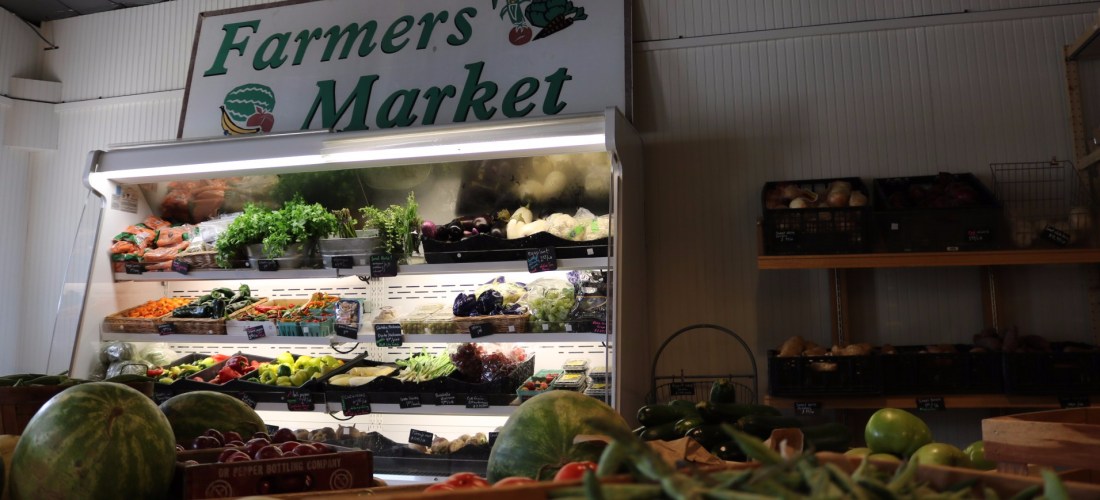
Since its soft opening in June the Chicory Market, at the site of the old Oxford Farmer’s Market store, has been growing closer to their community and local farm suppliers.

“Our goal is to first and foremost give the farmers and the food makers a place to sell their goods, and as a result bring a community together,” co-owner Kate Bishop said.

She and her husband John Martin took over the store from former owner Liz Stagg who operated the business for twelve years. The couple returned to Bishop’s home in Mississippi from New York because they saw the need for this kind of connective food service around Lafayette County as well as the country.

According to the Mississippi Food Policy Council, the state of Mississippi has 41,959 farms amounting to over 11 million acres of farmland. However, the state ranks near the top of the lists for states with the highest amount of food insecurity. Stores like the Chicory Market are working to connect Mississippi’s vast agricultural resources with its hungry population.

Bishop wants to help her customers be able to put a local face on the food sold at her store. She said that some farmers were initially skeptical of the new venture because she hadn’t lived in Oxford since she was little, but that their relationships have grown over the months.

“We’re providing them a place of business and that feels good and healthy,” she said. 

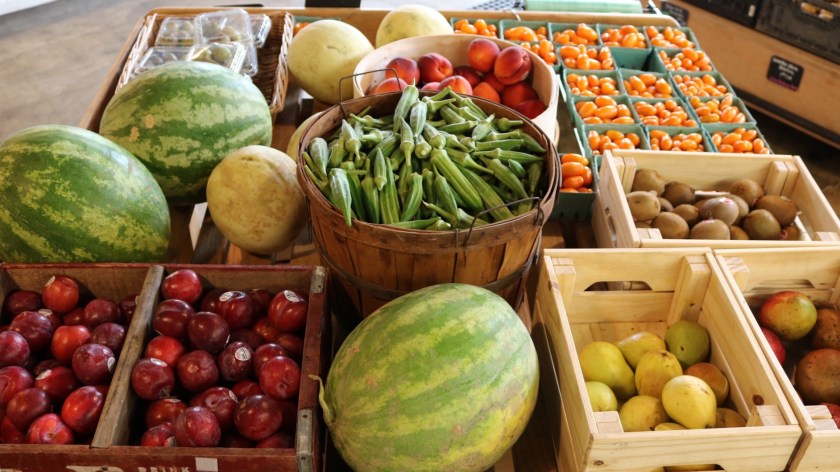
The store has brought together around 50 different food makers -including but not limited to farmers- providing accouterments like dried cranberries, yogurt dipped pretzels and gelato as well as fresh produce.

Often customers can even catch vendors in the store as they drop off their wares; Matt Britt of Clear Creek Produce has recently been in the store to stock watermelons, zucchini squash, and sweet corn. The Mississippi State graduate’s 17-acre farm is located off of Highway 6 on the way to Batesville and has been in his family for over 150 years.

He said he’s noticed an increase in people wanting to eat healthily and locally and says that it provides him an advantage as a local supplier.

“That squash was picked a few hours before it was put in here to buy,” he explained. “Versus a tomato that comes from California that might be five or six days old and possibly rotten.”

“I think the local drive these days is really helping local farmers,” he said, noting that he has serviced the farmer’s market since 2008, and that about a month ago -before the weather concerns- he stocked almost 90% of the store’s produce.

But a rough summer has been a setback for the and other farmers in the area. “One day we were out picking watermelons and I left my truck running and we were at 116 degrees,” Britt explained, “At high temperatures like that plants tend to struggle.” He said the heavy rains over the last few weeks have also caused plants like tomatoes, watermelons, and peppers to absorb too much water and burst.

ChicoryMarket1

Fresh produce dots the tables of the new Chicory Market. Photo by Olivia Morgan

He and his staff are working hard to get a fresh crop of tomatoes in within the next two weeks and continue to supply squash and greens through the winter.


The market has also been struggling to secure a supply of eggs- hampered by local chickens not nesting during the heat. In the meantime, they have crops of local figs, squash, and zucchini that are still coming in fresh. 

 “We thought we would have down time to expand the grocery section and we’ve spent all of our time trying to manage where we get tomatoes and eggs,” Bishop said. Although things have not gone as smoothly as expected, she said the community has been key in giving the store time to open, and she still has big dreams for the future.

Laurie Stirratt, who worked for the former farmer’s market store for three years, has helped to ease the transition between owners and plans to begin selling prepared foods soon. She will use inspiration from her home of New Orleans to provide gumbo and jambalaya in the fall as well as Mediterranean meals and grain salads.

Stirratt said that the farmer’s market has long filled a need for fresh food in Oxford and that there are more local growers now than ever, due to an increased interest in local foods. 

“People like to know where their food comes from, and I think that we give an amount of customer service that you don’t get at Kroger or bigger stores,” Stirratt said. They also plan to offer events with live music and food trucks later in the fall to engage with the community.

Bishop plans to install a map near the register of Chicory Market before their grand opening- highlighting the many places across the area where their foods are grown like Yokna Bottoms, Canebrake Farms, and Native Son Farms of Tupelo.

Bishop said that forging a relationship with farmers and customers is easier in Mississippi than in New York. “There’s a sense of community that is more natural here that is easy to establish just because you know that you are gonna see these people daily,” she said.

She is grateful to the many people who have volunteered their time and gone above and beyond to help the new store open, and help a longtime Oxford staple grow into a new chapter.