Collaboration with Kendall Patterson and Smiley Poole for the 2018 Lens Collective Conference
Author: olivialeamorgan
Lens Collective 2017- Searching for Robert Johnson
ProjectsCollaboration with Rachel Clark and Smiley Poole as part of the 2017 Lens Collective Conference
Stafford Tile and Stone- Reels
ProjectsCulture Aid NOLA partners with Footprint Project for the planet
Writing
Culture Aid NOLA (CAN) is working with Footprint Project through a grant from Elevance Health Foundation to build more green and efficient operations. More than 400 families are served with free, fresh produce at each of CAN’s twice-weekly no-barrier no-stigma grocery distributions, and through solar innovations Footprint Project aims to reduce energy use at these events.
Footprint Project, with support from Elevance Health Foundation, the philanthropic arm of Elevance Health, is partnering with CAN, Sprout NOLA, and New Orleans Community Fridges to provide solar + battery solutions for local community coolers. The Healthier Power initiative will ensure that pillars of the food security community remain resilient through disaster power outages, eliminating both food waste and greenhouse gas emissions.
“How can we help power your mission? At Footprint Project, this question is always at the core of our work. We are thrilled to be partnering with Culture Aid NOLA, whose non-traditional food bank model is a mission we’re honored to help power,” said Jamie Swezey, Footprint Project Program Director.
“The partnership with Footprint Project gives Culture Aid NOLA relief going into summer months and hurricane season. Working through blue and grey skies, it is crucial for us to have access to temperature regulated coolers to store food and access to power to continue operating on site,” said CAN Executive Director Ellie Duff.
Items like solar-powered generators, panels and temperature regulated coolers from the Footprint Project will ensure that Culture Aid NOLA can continue serving free food while keeping families comfortable and food fresh, on a weekly basis and in response to local major weather events.
“Many of the communities we serve are severely impacted each year by some type of natural disaster. By expanding our community resiliency and disaster relief grants, we are able to make a greater impact not only in the communities we serve, but for the individuals who are impacted as well,” said Shantanu Agrawal, M.D., Chief Health Officer of Elevance Health.“Together with our partners, Elevance Health Foundation will continue working to measurably improve disaster preparedness, response, and recovery efforts throughout the country.”
This new technology will power CAN through extreme weather events like Hurricane Ida, and more chronic climate issues. Due to record-breaking heat last summer, CAN had to cancel almost all late afternoon distributions in the month of August for the safety of volunteers and guests. With increased temperatures throughout the summer, being able to power misting fans and charge pallet jacks with solar power will allow CAN to deal with the effects of climate change without contributing further.


Footprint project has provided solar rechargeable batteries and a solar-powered cooling trailer that is helping Culture Aid NOLA to store and distribute produce to local families.

The Balm Before the Storm
WritingFor The Center for Disaster Philanthropy
We’ve seen it happen disaster after disaster, since before Hurricane Katrina and most recently in Florida with Hurricane Ian. No matter how early we know a storm is heading our way or what level of impact it might have, and no matter how many times the experts tell us to leave or how to prepare, some people will not evacuate, even if that seems like the most logical option.
For some of us, evacuation is not an option. There’s no viable or affordable place to evacuate to, no transportation to get us there or we are physically unable to make the long and arduous trek. These are all legitimate reasons for staying put with a plan to shelter in place. So, we prepare as best we can, securing the supplies to get us through. But, for many, this, too, is not possible.
Stocking up on supplies and preparing for long-term power outages or damages to other critical infrastructure is expensive. It is not an option for many living paycheck to paycheck or on a fixed income. The results of this lack of options can be devastating, as happened most recently in Florida, with the deaths of those unable to evacuate and prepare for the hurricane’s wrath.
How can local, nonprofit organizations, with the help of grantmakers, donors and partners, pre-position emergency supplies to provide to people who cannot purchase or access them?
What are our options?
In the first 72 hours after a disaster, supplies such as water, shelf-stable foods and initial clean-up tools are crucial for survival. But often, they sit congregated in warehouses, beyond the reach of last-mile delivery systems that will be down for weeks. Resources are less likely to make it directly into homes after a storm as streets are blocked, roads flooded and public transportation halted.
At Culture Aid NOLA, we believe the best place to pre-position donated items for hurricanes and other major disasters is in the homes of local families not miles away and unreachable in warehouses. That’s the idea behind July Supply, the first-of-its-kind disaster preparation distribution for our community, which we often see being left behind in this response.
Culture Aid NOLA piloted July Supply last summer and leveraged a $50,000 grant from the Center for Disaster Philanthropy with more than $730,000 worth of donated goods and $24,618 worth of volunteer labor to serve 2,000 New Orleans families.
Partnerships with organizations including Can’d Aid, Conscious Alliance, Good360, Second Harvest Food Bank and more helped us source supplies for the beginnings of a “Hurricane Kit” for local families. The kits, which included more than 3,800 flashlights, 48,000 cans of water and 22,000 cans of sanitizers, were distributed at the community event on July 16 in New Orleans’ City Park.
“We were very impressed with the responsiveness and transparency of Culture Aid NOLA,” said partner Can’d Aid through the July Supply After-Action Report. Another partner also shared, “The pre-disaster approach was greatly appreciated. It gave us time to provide support and was not the norm for us as we are usually scrambling to provide support during a response.”
Getting supplies in our neighbor’s homes ahead of time gives families peace of mind before something catastrophic hits.
Why should we prepare?
In the face of rapidly intensifying storms, like Hurricane Ida in 2021, and inflation, the realities of evacuation are causing more and more families to question leaving. New Orleans’ City Assisted Evacuation Plan only accounts for 10% of citizens who don’t have cars or who have major medical needs in the face of a mandatory evacuation while almost 20% of New Orleans residents do not have a car, and 26% fall below the federal poverty level. With less accessibility to evacuation for some populations and less time to evacuate, it’s imperative to prepare communities before with supplies to last the first 72 hours of a storm.
The federal poverty line does not include undocumented persons, displaced persons, evacuees, and families that make just above the federal poverty line, who are Asset Limited, Income Constrained, Employed (ALICE). The United Way of Southeast Louisiana believes up to 57% of Orleans Parish residents are struggling households without the extra funds to leave town in the face of a storm.
These underserved communities are who Culture Aid NOLA aims to serve at our twice-weekly free grocery distributions without imposing stigmas or barriers like proof of identification, residency or income. We believe that everyone deserves access to resources to feed their families and prepare them in the face of disaster.
What’s next?
We plan to make July Supply an annual event in New Orleans. We’re sharing our story and experience with partners along the Gulf Coast and beyond so they explore replicating the program in other communities.
Keeping our neighbors prepared and ready in the face of increasing disasters is key to our communities’ equitable and speedy recovery.
Ellie Duff is the interim executive director and Olivia Morgan is communications manager of Culture Aid NOLA.
A Brush With Kindness: Mary Porter
Writing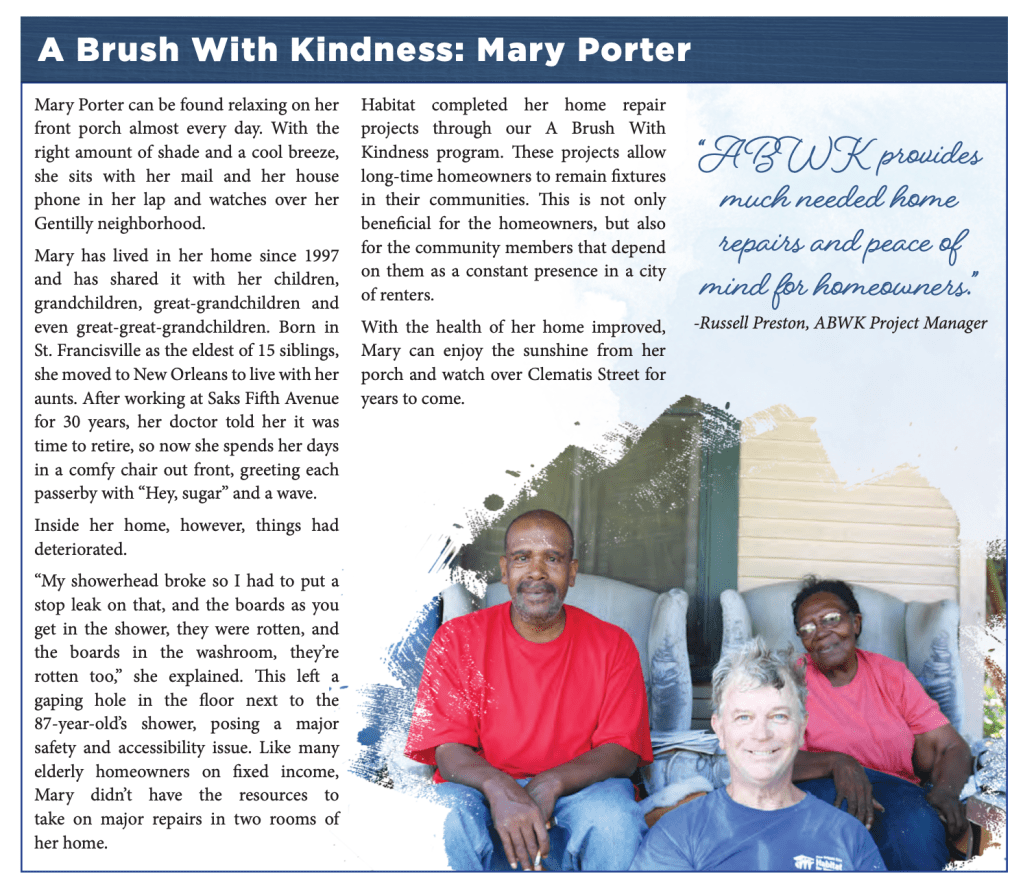
Forever Home
WritingNew Orleans Area Habitat for Humanity Annual Report, 2019
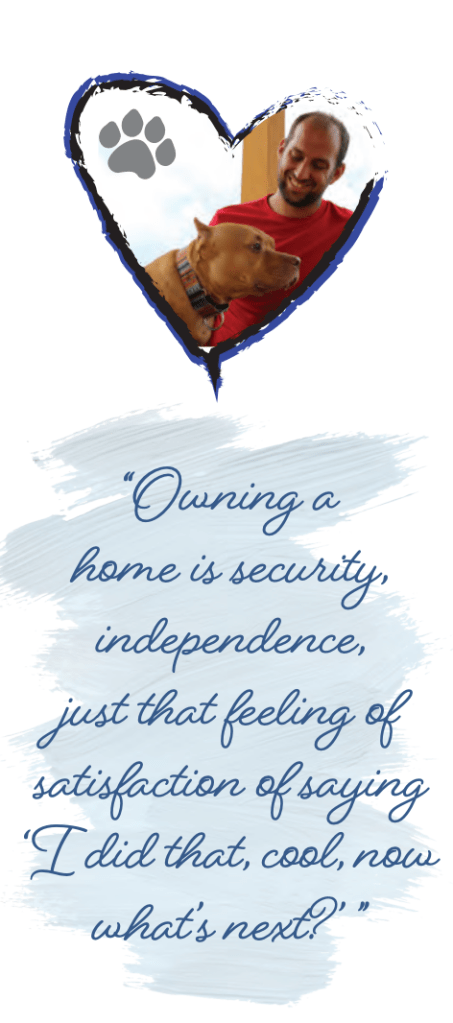
Tim Gray already knows how good it feels to find a “forever home.” While he’s new
to our First Time Homebuyer Program, he’s been delivering dogs to their adoptive
homes for three years now with the Villalobos Rescue Center.
Tim works and currently lives inside their main facility that houses hundreds of dogs of all breeds awaiting adoption. The shelter is the basis of Animal Planet’s show “Pitbulls and Parolees.” He began
volunteering with the nonprofit as a way to stay active, and took on a full time position with the organization in 2016.
Tim helps with transports, observes and records dog behavior for analysis, and makes sure his four-legged friends get the fresh air, activity, and socialization they need. The Vermont native has worked other jobs, from being a road manager for a punk band to kitchen work and management, but he’s learned
over the years that he far prefers working with dogs.
“I spend pretty much all day outdoors, which is great because I’m not cooped up inside,” he said. Tim also enjoys skateboarding and rock climbing and is a natural fit for working sweat equity hours on Habitat build sites.
“I’m a fairly self-motivated person, so I don’t like being idle,” he said, “I know that with homeownership, my dad tells me there’s always something to fix.”
Tim heard about the program through his friends and Habitat homebuyers Tyler St. Jean and Sarah Wood, who explained he didn’t have to be married or have children to apply. Not that Tim is really childless—he’s got three pitbull mixes: Jones, Alasaurus, and Gumba. Jones has been with Tim since he moved to New Orleans 12 years ago, and Alasaurus joined them when Tim lived in Holy Cross.
He met his 60 lb. “baby” Gumba two years ago when the butterscotch puppy was brought to Villalobos. After eight months of fostering, Gumba joined Tim’s family, and now he will get to live outside of the
kennel in his own home for the first time. With that in mind, Tim selected a lot in the Lower Ninth Ward that has a big tree with lots of shade, a park just down the street for the pups to play, and less than a ten-minute commute to Villalobos. For Tim and his dogs, the house he will build there is a testament to years of work and personal growth to reach independence.
“I spent a lot of my life doing things that I thought would make people like me instead of what I actually liked to do, and unfortunately that led to a few problems down here,” he said. He doesn’t like to think of this as wasted time, but rather years when he found out what didn’t work. Right before he started working at the rescue, he decided to get sober. He said everything since has been a step forward to a more stable chapter
that includes something he never thought he would be able to achieve: home ownership.
“Owning a home is security, independence, just that feeling of satisfaction of saying ‘I did that, cool, now
what ’s next?’ ”Tim looked at several home-buying options before coming to Habitat, including a grant program and a traditional mortgage from a local bank.
“It’s a little daunting and a little confusing when you see all these numbers thrown at you,” he explained, “That’s why I liked this program. The time taken to educate you and really set you up to succeed, and how it’s broken down to where it’s not this whole big thing that you have to do to get to a house.”
He credits his caseworker Patsy for answering his questions, working with him to meet qualifications, and removing the pressure from the process. He said he’s thankful to be a part of a program that helps people help themselves and providesa way for people to gain autonomy for themselves and their families.
A Rumination In Decay
Writing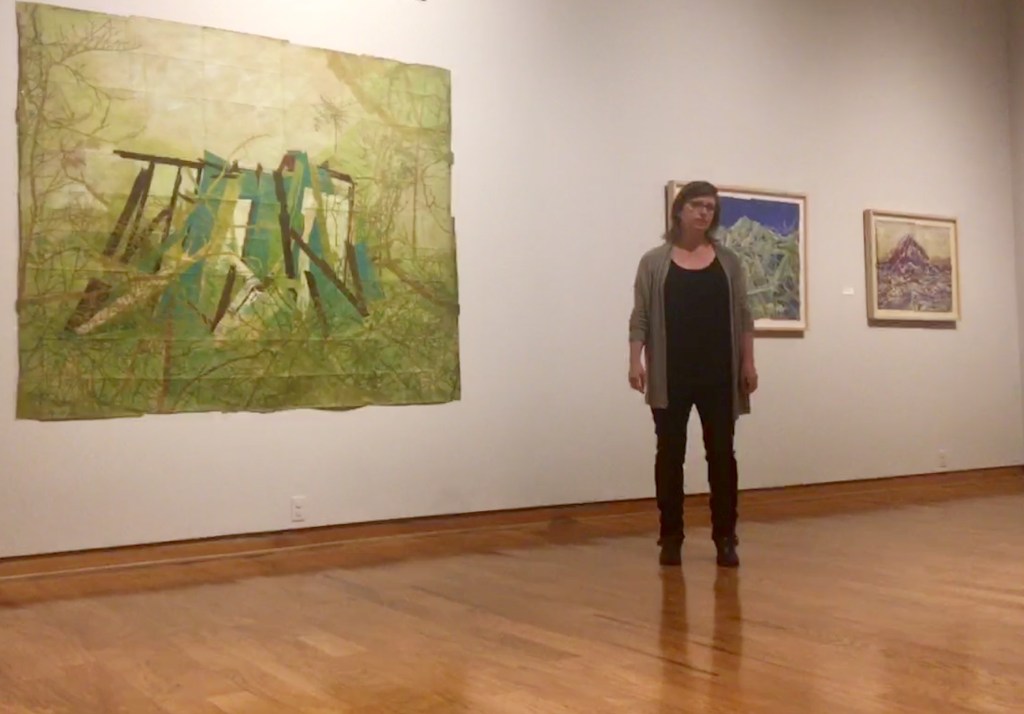
In her show at the University of Mississippi Museum, Ruin is a Secret Oasis, artist Maysey Craddock reflects on the inevitability of entropy, and the natural progression of the earth after human forces have abandoned a space.
In the collection’s focal piece “somewhere south of Violet,” blocks of blue and brown lean upon themselves while being eaten by her creeping lines of light green flora, growing up from the bottom of the painting. Her pieces employ a high level of abstraction, giving the viewer a puzzle to decode — to find the lines of the house while differentiating it from what has grown up around it.
“People are not in the work, but humanity is in there,” Craddock said. Most of her work is landscape-based, but includes man-made structures in the early and late stages of decay.
“I was really interested in the idea of ruin and nature and that kind of collapsing of architecture and the reclamation of nature,” she explained.
The artist, who returned to Memphis in 2008, said she has come to see ruin in her everyday life, including a gaping hole in the top of a building next to her studio. She finds inspiration and sense of place in the works of fellow Memphian and photographer William Eggleston, and also looks to the sublime landscape paintings of the early 1800s. Her appreciation of form and construction comes from her training in sculpture.
She works from line drawings made from carbon paper and photographs she’s taken of run-down shelters on road trips through the deep south, pulling from places like rural stretches outside of her home in Memphis, the Mississippi Delta, the Alabama coast, and isolated lands south of New Orleans in Louisiana. Sometimes she seeks to find places, sometimes the places find her.
“I’m interested in that place where land and water meet, that really ephemeral landscape and so it’s a little political for sure, how are we preserving the landscape,” Craddock added, “And also, of course there are larger geographical forces at play.”
Craddock said that she is drawn more to matte and velvety textures, as opposed to oils. Her work is painted on used paper grocery sacks, sewn together with silk threads. The materials use suggest a “foundness” to the work, a tactility that feels more authentic than a traditional canvas. She said that sometimes when she collects the bags from friends she often finds receipts and shopping lists within the bags, giving them a sense of material history.
Though abandoned, her pieces also have a profound sense of movement. In one pieced, entitled “Gravity Sky” sharp white directional lines show the explosion of a home. These gestural strokes against a grey wash background make the building appear as if a tornado is deconstructing it in the very moment. Craddock said this piece led her where it wanted to go, becoming less and less constructed as she worked on it.
She paints with gouache, an opaque watercolor, often creating washy swatches with layers of more intricate details. She uses a variety of hues, from stark blacks and whites to deep greens, and even ocher reds. She said a large piece takes her 3–4 weeks, adding “I always work from a vision, but most of the time the piece just says no.”
The piece entitled “Slow Burn” comes from a roadside stop near Jackson, Mississippi captured at noon in mid-August. The painting depicts a scorched structure that had devolved into a spidery-like crumple of metal beams creating interesting geometry. She uses hot blues and searing reds in wavy lines to waft the heat wave off of the page.
She also employs darker tones in a piece where the background of a shed is deeply blackened, save a few fingers of white spilling down the page, stretching and branching like bolts of white hot lightening. The piece gives one a sense of being underwater, with the building suspended in place by these white lines.
Her use of line — to lead the viewer’s eye, and to depict tree-line branches as well as coastal water currents — takes viewers into a dreamlike land where what has been touched by man has been made untouched by mother nature again.
Jazz Amistad
ProjectsReplanting After the Storm
WritingSustainable farming in the U.S. Virgin Islands recovering with the help of North Mississippi natives

Nate Olive watched till nightfall as Hurricane Maria rolled in over the west end of St. Croix Island. He said goodnight to his sown tropical paradise of fruit orchards and vegetable fields, pastures of sheep and guest-hosting cabanas. As the winds of the storm began howling like a freight train, he descended into the on-site hurricane shelter.
He had been on this property, now the Ridge to Reef farm, for over 13 years managing farm outreach and educational programs as part of the Virgin Islands Sustainable Farming Institute until he purchased the land himself. His farm helped introduce the concept of a community supported agriculture program, or CSA, to the territory in 2010. Their CSA has since has grown to include over 400 members and encouraged four other farms on the island to take up similar practices. Typically joined by six to 10 staff members on the farm, Olive and two other staffers and a visiting couple were on the property when Maria struck.
Maria came in the middle of one of the heaviest hurricane seasons in recent history, according to the National Weather Service.
“Maria gradually intensified and became the 8th hurricane of the 2017 Atlantic hurricane season with 75 mph maximum sustained winds,” the NWS said. Following other destructive storms like Harvey, which battered the Texas coast and Irma, which also made landfall in the caribbean islands, Maria would prove to be a further blow to an already damaged, and oft forgotten section of United States territory.
“Every little detail was brown”
Olive had ridden out other storms on the farm before, like hurricane Omar in 2010, but nothing had prepared him for cracking the doors of the bunker open the next morning and coming out into a completely different world. “It definitely looked like a war zone,” Olive said. “Every little detail was brown.”
Olive’s thoughts quickly turned to rounding up sheep and donkey that roamed the property. He found them tangled between trees. He was surprised to find his own home dinged, but relatively untouched.
https://cdn.embedly.com/widgets/media.html?type=text%2Fhtml&key=a19fcc184b9711e1b4764040d3dc5c07&schema=facebook&url=https%3A//www.facebook.com/n8olive/videos/10107745935430150/&image=https%3A//i.embed.ly/1/image%3Furl%3Dhttps%253A%252F%252Fscontent-iad3-1.xx.fbcdn.net%252Fv%252Ft15.0-10%252Fp75x225%252F22012503_10107745948663630_1810292800747470848_n.jpg%253Foh%253Dfbf3906dff3cdbff2b90234d539e6ffc%2526oe%253D5A8E4D4C%26key%3Da19fcc184b9711e1b4764040d3dc5c07First footage of Ridge to Reef farm after Hurricane Maria of farm workers recovering donkeys. Video courtesy of Nate Olive.
Yet he was severed from the outside world: the solar panels that powered the property lay crushed, and cell service was a rarity. Olive can travel to a certain hill on the island where he gets service to send out text messages and place calls. There was a place where he had internet that he could go to every two or three days and it was there that he posted Facebook updates and replied to those who had reached out to help.
Their crew of four would spend four days cutting half a mile up the drive to the main road, only to find the street itself impassable.
Before this land was a jumbled mess, it was a 180 acre functioning farm, a tropical agro-tourism destination and a place of inspiration for Como, Mississippi farmer Marshall Bartlett.
“They planted lots of native species and there are tons of trees,” Bartlett remembered, “They built these really neat structures like cool treehouses.” Ridge to Reef was also selling to the farm-to-school program under contract with the local school system.
The first time Bartlett came to the farm he was seeking a reprieve from a cold winter semester at Dartmouth, opting to take an eight-week apprenticeship at the then-Virgin Island Sustainable Farming Institute in St. Croix. He credited this time as formative in the creation of his own Home Place Pastures.
“There were several people from multigenerational row crop farms in the south trying to figure out what to do with their place and move their farm, and how they sell agriculture in general,” Bartlett said. They discussed building their farms as places to engage their communities that had seen a decline in jobs and access to healthy foods.
“I was only 19 so it definitely stuck with me and that’s where I sort of started to form the idea to come back and do what I’m doing now,” he explained. During his stay there he also learned green building techniques and animal husbandry practices that he employs at his own farm.
“When I saw pictures of the farm after the hurricane it looked like somebody went with a chainsaw and cut everything two feet above the ground,” he said. Due to the strong impact this farm has had on his own career, he reached out to the Ridge to Reef Farm via email, but his attempts were futile as the island is still mostly without internet service.
Once they finally got in touch the team hit the road on November 8th, trucking down to New Orleans to stay the night at the home of their NOLA sales representative before catching a 6 a.m. flight to St. Croix.
Team member and Home Place Pastures Chief of Operations Andy Stubblefield said the destruction was evident even from the air.
“They have all these FEMA tarps that they put over damaged roofs, and when you fly in you can see that pretty much every house had one of those tarps on top of it,” he said.
The airport, which had been the focus of most of the relief efforts, was in the best shape, but once the crew began to drive out into the country and up the mountain that the farm was on they began to notice demolished homes and downed power lines.
“You can’t rent a car there, all of the lines are down, all of the infrastructure of the island is just gone,” Bartlett explained.
He had returned not to the sunny shores of his youth, but to an island two months post-hurricane, struggling to return to normalcy. Gone was the local sleepy bar on the beach that he and his fellow farmers would hitch-hike to at sunset.
“A lot of the beaches you can’t swim in right now because the sewage system had flooded and there’s contamination in the water,” Barlett lamented.
The team members were housed not in tropical resorts, but the screened-in cabanas that had slept guests at the farm before the storm. The cabanas were still without electricity and running water when the team arrived.
“We weren’t expecting anything glamorous, we were down there to work,” Stubblefield explained.
Mother nature has seemed to recover more quickly than her children on the island. The brownness that covered everything began to flow across the property as heavy rainfall and flooding continued even after Maria had passed. Saturated farm soil no longer imposed by tree roots began to cover the roads like rivers.
There’s grass now. The deep muddiness from the rain has rendered swampy stalks ten feet tall. Bush cloaking debris on the ground, vines encasing downed trees. Vegetable crops sit ruined and rotting in the fields, munched on by stray animals.
What equipment the farm had has been put through the blender. Mowers were blown out hitting hidden shrapnel from the storm in the seeping weeds. The farm had a tractor, but it was in the shop during the hurricane. The shop was blown off the map and the mechanic was evacuated out for dialysis.
For Olive, the Home Place Pastures team would be a skilled set of hands and a boost in morale for his operation.
Bartlett and his team consisting of Stubblefield, marketing head John Jordan Procter, CSA organizer Alison Schruder and farm intern Andrew added hands where needed.
“Fruit trees from the CSA had been tipped over, and that was one of the big projects we had one day, going to each tree and pruning them and trying to push them up and support them with other trees so that they had a chance to survive and continue to produce fruit,” Stubblefield said.
The team also worked to repair grazing pasture enclosures that had be crushed by fallen trees. They worked sun-up to sun-down chainsawing trees, making burn piles, carrying trees through the brush and doing fence work.
Stubblefield said he was most impacted by seeing the affect that Ridge to Reef had on the island community. “Pretty much everywhere we went the people knew the farm and were very appreciative of us coming there and helping out,” he said.

Olive said Bartlett was well suited to the task because of his background in farming, and his team of skilled and willing workers. “I had never met anyone else on his team in my life, but we all bonded instantly when they saw what we are up against,” Olive said.
The team was a welcome antidote, but not a full cure. While other visits from farm supporters are in the works, healing the land isn’t Olive’s sole concern. Mortgage payments, phone bills, health insurance payments are all still due, storm or no storm. On top of that, he’s having to replace broken equipment just to get the business started again. Farming is about patience. Planning, timing, sticking to your task until it’s done, but the farm is not even in the position to plant.
According to FEMA, 6,352 individual assistance applications have been approved and $105, 405, 080 in public assistance grants have been obligated. However, farms like Ridge to Reef make too much gross income to apply for such federal assistance, mostly aimed for individuals and family households. General loans are hard to come by because of the farm’s low net profit. The island is operating on a mostly cash-only basis, which is difficult in a place without internet service for ATMs.
“The best solutions I’ve seen aren’t institutional help but individual help,” Olive said, “It’s not federal it’s just people helping people, no strings attached.”
The farm has been mailed supplies from friends across the country. There is a GoFundMe started to raise money for a tractor. He says as much as the storm surge shocked him, he is equally overwhelmed at knowing how much support he has from people, even those he hasn’t been close to in years.
“I didn’t really know that we did something good for them at some point in their lives,” Olive said. He’s got a long road ahead of rebuilding sheds and greenhouses, and getting the farm back to sustainability.
“A storm like that just effects every little detail. It just twists and bends and breaks every corner of everything,” he said. “All you can do is pick one thing and do it till it’s done. If you try to think of the whole list at once it will drive you crazy.”
 Olivia Lea Morgan Sax

